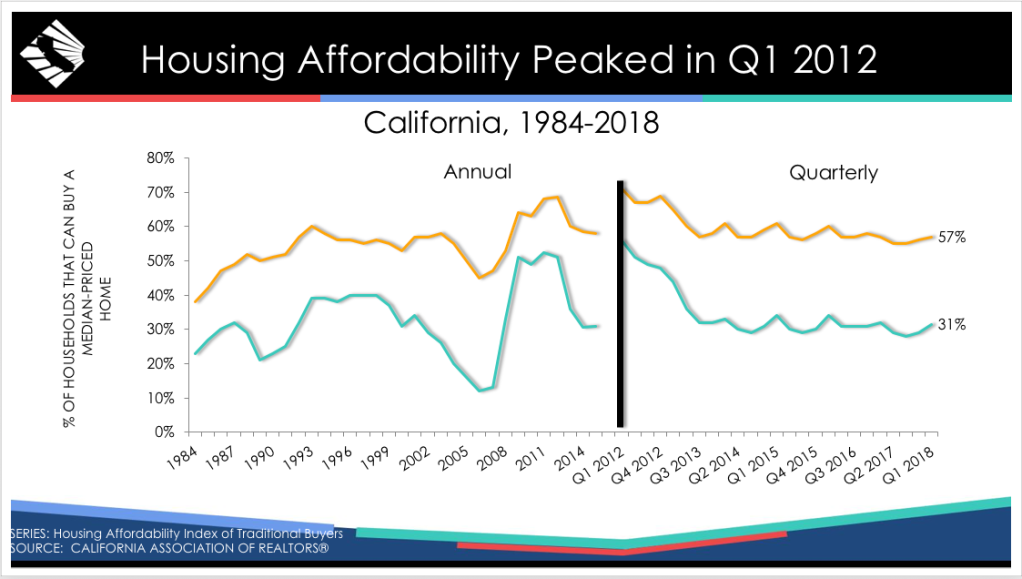
Higher wages and lower seasonal home prices combined to push California’s housing affordability higher in the first quarter of 2018, compared to the previous quarter, the CALIFORNIA ASSOCIATION OF REALTORS® (C.A.R.) said Tuesday.
The percentage of home buyers who could afford to purchase a median-priced, existing single-family home in California in first-quarter 2018 edged up to 31% from 29% in the fourth quarter of 2017 but was down from 32% in the first quarter a year ago, according to C.A.R.’s Traditional Housing Affordability Index (HAI). This is the 20th consecutive quarter that the index has been below 40%. California’s housing affordability index hit a peak of 56% in the first quarter of 2012.
C.A.R.’s HAI measures the percentage of all households that can afford to purchase a median-priced, single-family home in California. C.A.R. also reports affordability indices for regions and select counties within the state. The index is considered the most fundamental measure of housing well-being for home buyers in the state.
A minimum annual income of $111,500 was needed to qualify for the purchase of a $538,640 statewide median-priced, existing single-family home in the first quarter of 2018. The monthly payment, including taxes and insurance on a 30-year, fixed-rate loan, would be $2,790, assuming a 20% down payment and an effective composite interest rate of 4.44%. The effective composite interest rate in fourth-quarter 2017 was 4.17% and 4.36% in the first quarter of 2017.
Condominiums and townhomes also were more affordable in first-quarter 2018 compared to the previous quarter with 39% of California households earning the minimum income to qualify for the purchase of a $449,720 median-priced condominium/townhome, up from 38% in the fourth quarter. An annual income of $93,090 was required to make monthly payments of $2,330.
Key points from the first-quarter 2018 Housing Affordability report include:
· Housing affordability improved from fourth-quarter 2017 in 28 tracked counties and declined in 14 counties. Affordability in six counties was unchanged.
· Strong wage growth in the San Francisco Bay Area pushed affordability higher from the previous quarter in six of nine Bay Area counties (Alameda, Contra Costa, Napa, San Francisco, San Mateo, and Santa Clara). Affordability decreased in two Bay Area counties (Solano and Sonoma) and held steady in Marin.
· In Southern California, affordability improved in Los Angeles, Riverside, San Bernardino, and Ventura counties, while affordability in Orange and San Diego counties remained flat during first-quarter 2018.
· In the Central Valley, six counties posted an increase in affordability from the previous quarter (Fresno, Kern, Madera, Sacramento, San Benito, and Stanislaus). Affordability in Merced, San Joaquin, and Tulare declined but held steady in Kings and Placer counties.
· Affordability in the Central Coast improved moderately, driven by flat or declining home prices. Monterey, San Luis Obispo, and Santa Barbara experienced higher affordability, while Santa Cruz posted a decline as a result of subdued wage growth and price declines.
· During the first quarter of 2018, the most affordable counties in California were Lassen (68%), Kern (56%), and Kings and San Bernardino (both at 52%).
· Mono (8%), San Francisco, San Mateo, and Santa Cruz (all at 15%), counties were the least affordable areas in the state.