Websters defines well-being as a state of being happy, healthy, or prosperous.
No details in the definition itself specifically explain how or why people reach that state. Does it just happen? Is it a condition simply to wish for, or is it the result of intention, agency, striving, deserving behavior and discipline?
If you pick at the term and unpack the words “happy, healthy, or prosperous,” a clue may surface. To prosper is to thrive or flourish or gain success, but in that word one would have to agree that there is at least a note of effort, of ethic, of work toward a purpose, of give before take that gives prosperity its essential meaning.
So, well-being then, might rightfully be characterized as “earned,” not merely hoped for, expected, or even less so, dreamed about.
Buying a home on a piece of property in a community shares, we think, so much in common with the state we call well-being that, in many respects, they’re barely distinguishable. Each are earned, although neither is a guaranteed outcome of like efforts, equal exertion of energies, similar measures of agency or effectiveness. With the same sweat equity, one might amass resources enough to attain homeownership, while another might be said to deserve it, but alas. Why? They each start their quest from a different base of resources, each might live in a different market, each may have different demands on the household income.
All this is to tip our hats to new-home builders and their collective teams of sales associates, whose job it is to make both well-being and new homeownership an achievable state for more people, and whose results in November of this year exceeded those of any of the past 10 years and four months.
Looking at the numbers in a crass way that economists never would, but home builders and their operations and sales and marketing teams might, if you take the November trailing 12-month run-rate of 733,000 single-family home sales, and factor for the 26.6% difference in pace one year ago (579,000 in November 2016), builders and their sales and marketing associates reeled in annual orders at upwards of $60 billion more annually than 12 months ago.
Two take-aways emerged from pre-Christmas reports on the sudden surge in new home sales, which lifts year-over-year orders by 9.1% over 2016 through November. One is that pent-up momentum in the wake of this past Fall’s hurricane barrage released faster and stronger than expected in the nation’s southern markets of Florida and Texas. Zelman & Associates analysts affirm this momentum showing up in proprietary builder survey data in the latest The Z Report (available on a free trial basis by clicking here.)
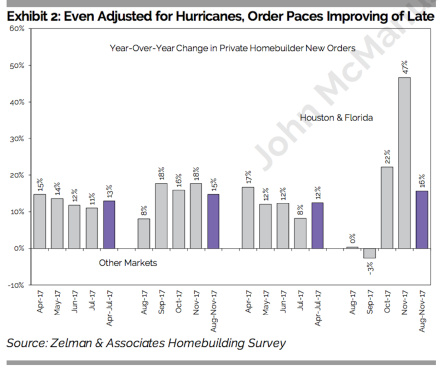
In November, our survey revealed a 23% year-over-year increase in new orders across the country, solid acceleration from 17% growth in October. The growth was led by storm-impacted markets (Houston and Florida) as demand appears to be rebounding quicker and stronger than anticipated following Hurricane Harvey in August and Hurricane Irma in September. Specifically, Florida orders jumped 53% after a 22% increase in October, while Houston orders improved 26%, marking the third straight month of 20%-plus growth after Hurrican Harvey.
The other is the stark reality of attainability. Seven out of every 10 new homes sold during the first 11 months of 2017 carried a price tag lower than $400,000, and in November itself, the share of new homes sold for higher than that $400,000 mark declined. Price elasticity seems to reach its upper tolerance level at $399,000, while clearly, we have not begun to see how those percentages would shift if more new homes came on the market at the below- $199,000 level.
Somewhere between $199,000 and $250,000–in many markets, that is, and that price-level’s relative equivalent in more expensive ones–a phenomenon builders might never have believed could ever occur again awaits some innovative enterprises’ ability to crack that code, and do it repeatedly. Market expansion–closing the gap between existing home sales rates and new home sales.
“We could sell homes at those price points all day long and never stop,” the CEO of a large multi-regional private home building company told me earlier this year. “We just can’t build them for that.”
That’s the rub. Solving for that challenge will take intention, agency, striving, deserving behavior and discipline, and one more thing. Doing things differently. If home builders and developers want people to channel their new, bigger standard deductions into down payments on a new home, they’re going to have to make a compelling case for what they can get if they do just that: well-being.